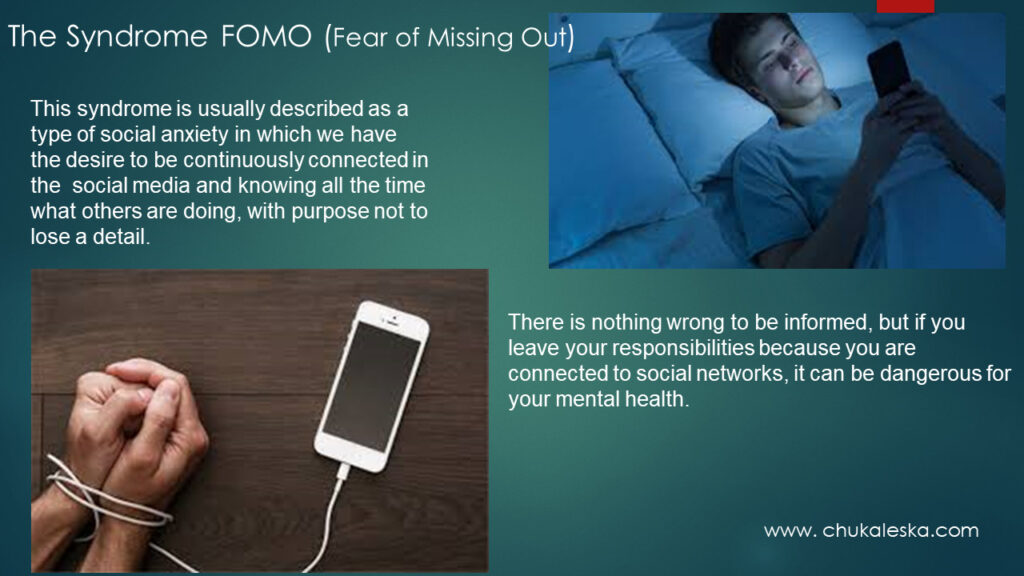

Since 2020, there has been a drastic increase of time spent on social networks. Through them you can communicate with other people or simply obtain some information (in the form in which the person who shares something “serves” us). The use of technology to keep in touch with your friends from a distance is the positive side of this epoch in which we live. But there is a fine line that if you cross you can become a “slave” of your phone.
Scientists have found a new term to explain this new phenomenon:
The FOMO syndrome (Fear of missing out). It’s a type of social anxiety with a feeling of being constantly connected to social networks in order to know what others are doing and not miss any details.
The immediacy that is one of the characteristics of the new technologies is what favors this possible obsession of always being informed. This phenomenon is further increased by the appearance of options on social networks to upload stories that disappear within 24 hours. That means if you don’t check you’re going to “lose” someone’s published story. Social networks use Neural Marketing Strategies – when things are fungible and have an expiration date, they engage the person more strongly.
We add more on that and the way the information is uploaded (images of happiness and fun), the person who stops doing his daily activities to spend time in the “virtual life”, in the passive way, feels bored with his personal life and lose focus on the essential things in life.
The key is to identify when you stop living your current life, you lose focus on yourself, your goals, activities, by spending time in your “Virtual Life”.
As adults let’s say that we have more tools to resist these temptations, but when it comes to adolescents and even more children, the possibility of developing this syndrome is very big.
Remember that the life you want to create and feel satisfaction are ALWAYS outside of your phone.
To evaluate yourself, pay attention to:
How much time do you spend daily on social networks?
Do you stop doing other things/activities/pending, because you are connected to your social networks?
Do you feel no satisfaction from your personal life, do you feel frustrated by comparing your life with others on social networks? Do you think your life is boring?
Anita Chukaleska psychologist, gestalt psychotherapist 09/09/2022